Our Location
1250 Beacon Street
Brookline, MA 02446
Explore the debate of air fryer vs oven to determine which appliance best suits your culinary needs and elevates your kitchen experience.
Surprisingly, 42% of U.S. households use an air fryer weekly. This shows the gadget’s growing popularity in home cooking.
This guide compares air fryers and ovens. It helps readers pick the right appliance for their kitchen and way of life. We’ll look at air fryer features, how they’re different from ovens, and things like cooking times.
The article talks about what air fryers and ovens are used for. It looks at cooking times, energy use, and how food turns out. It talks about the space you need, health benefits, and how to clean them. It’s aimed at home cooks, busy people, small households, and families in the U.S.
By the end, readers will know how to cook with either appliance. They’ll think about cooking time versus how much they can make. And they’ll be able to choose what adds the most value to their kitchen routines.
Today’s kitchens have many gadgets that change the way we cook. This guide looks at the basics of air fryers and ovens. It compares them and suggests what they’re best for.
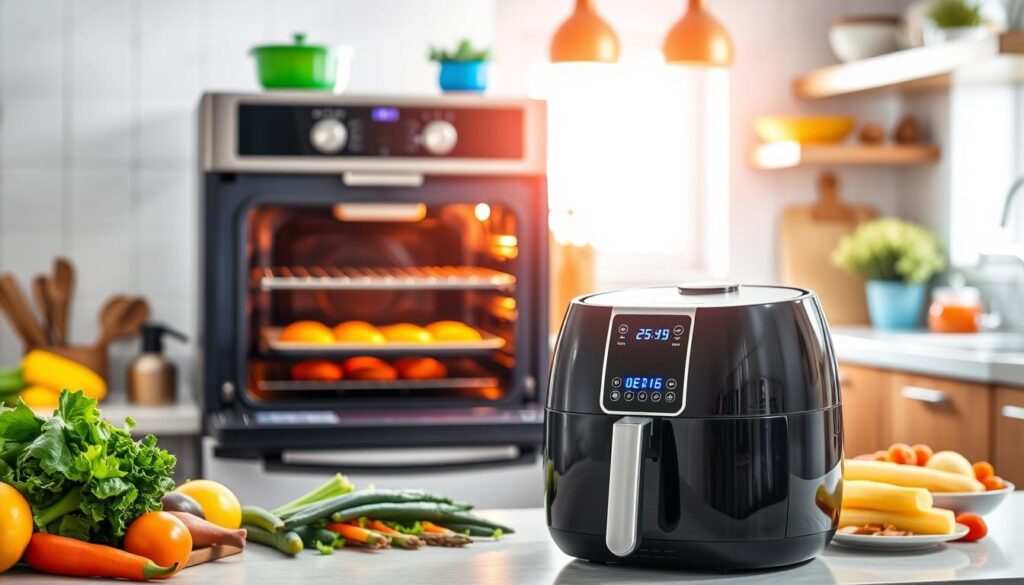
An air fryer is small and sits on your counter. It uses hot air and a fan to cook food quickly. Think of it as a mini oven that makes food crispy with less oil. Brands like Philips and Ninja offer different styles.
They come in sizes from 2 to 8 quarts and use 1200 to 1800 watts. Features include temperature control and presets for different foods. They’re great for quick cooking and crispy food without much oil. Plus, they fit well in small spaces.
A conventional oven can be part of your kitchen or stand alone. It uses hot air from electric or gas to cook food. You can find ovens from GE and Whirlpool, with electric, gas, or fan-assisted options.
They usually have 4-6 cubic feet of space and work with a lot of power. Modes include baking and broiling. They’re good for big meals and can do many things at once.
Air fryers are small and perfect for countertops; ovens are big and can hold more. Air fryers crisp food fast by blowing hot air in a small area.
When it comes to heating up, air fryers are quick while ovens take more time. But ovens can cook more food at once.
For energy, air fryers are better for small meals. Ovens are better for big meals despite using more energy over time.
Ovens can bake complicated recipes and serve big groups. Air fryers are best for making food crispy with less oil for smaller servings.
Air fryers cook food fast and keep it crispy outside. They use hot air and a strong fan to heat food evenly. This way, you get that golden crust with much less oil than deep frying. Keep reading to learn how it works and get some tasty recipes to try at home.
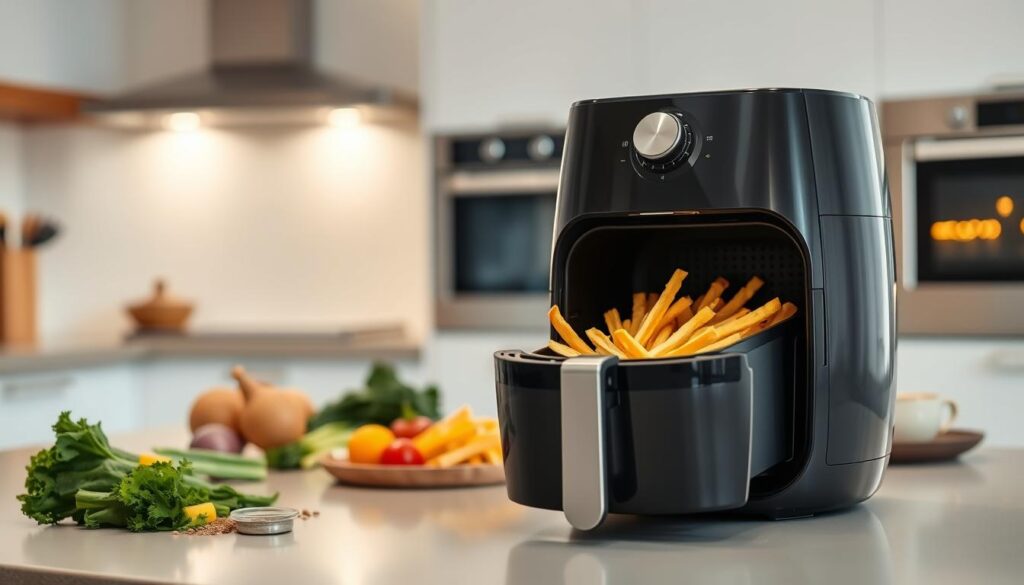
Air fryers heat up with a powerful heating element and move air quickly with a fan. This hot air surrounds your food, making it brown and crispy like if you pan-seared it.
They work at temperatures between 200°F and 400°F. You can set the temperature and time using knobs or digital controls. Some high-end models from brands like Philips and Ninja have extra features for even cooking.
These appliances don’t need much oil for cooking. A little oil helps make food crispy and tasty without the fat. For best results, don’t fill the basket too much, so air can circulate.
Features like basket shape and fan speed affect how your food cooks. Be careful with wet batters or loose crumbs as they can make a mess. Always check your food’s internal temperature for safety.
Frozen snacks cook up quick and get extra crispy. Air fryers do this faster than ovens and better than microwaves.
Proteins like chicken wings, salmon, and pork chops are perfect in air fryers. They get a nice crust but stay juicy. Veggies like Brussels sprouts and cauliflower get caramelized with just a bit of oil.
Try baking or making snacks in small batches too. You can make donuts, cookies, and roasted nuts easily. Reheating pizza or fried foods in an air fryer makes them crispy again.
For the best results, avoid putting too much in the basket, flip your food halfway through, and preheat if necessary. Using perforated pans improves airflow. Following these tips makes food cook faster and taste better.
| Recipe Type | Typical Temp | Time Range | Why It Works in an Air Fryer |
|---|---|---|---|
| Frozen Fries | 375°F (190°C) | 10–15 minutes | Direct airflow crisps edges quickly with little oil |
| Chicken Wings | 400°F (204°C) | 18–25 minutes | High heat produces a crunchy skin while locking in juices |
| Salmon Fillets | 375°F (190°C) | 8–12 minutes | Fast sear and short cook time preserve moisture |
| Roasted Vegetables | 375°F (190°C) | 10–20 minutes | Intense circulation encourages caramelization with less oil |
| Air Fryer Donuts | 350°F (177°C) | 6–9 minutes | Small batches bake evenly and brown on the surface |
| Reheated Pizza | 350°F (177°C) | 3–6 minutes | Restores crisp crust and avoids sogginess common with microwaves |
Conventional ovens are essential in American kitchens for their flexibility and ability to cook a lot of food. They use constant heat from electric or gas to bake, roast, and broil. Adding a fan, convection ovens create even air flow, making some dishes cook faster than in air fryers.
Heat is sourced from electric coils or gas flames. It spreads around by radiating off surfaces and moving naturally inside. When there’s a fan, it helps spread heat more evenly, avoiding uneven cooking.
Digital settings, probes, and broil options allow for accurate temperatures between 200°F and 500°F. However, it takes a while for ovens to warm up. But once they do, they keep a constant temperature perfectly for long cooking times and baking gently.
These ovens can cook many things at once on different racks. However, heat might not be the same on every rack or in every oven, so it’s good to rotate pans and watch how things are cooking. Without convection, crisping small items might take longer than using an air fryer.
Steady heat helps baked goods rise evenly. Cakes, breads, pies, and cookies need consistent temperatures to turn out just right. Using a thermometer that’s safe for the oven can ensure things aren’t overcooked.
Roasted dishes fill your house with delicious smells. Large meals, like whole chickens or turkeys, benefit from the oven’s size and the ability to use multiple racks. Slow cooking makes meats tender by breaking down tough bits and concentrating flavors.
Broiling uses high heat to brown the tops of dishes like casseroles and to finish off steaks. Meals on a sheet pan or casseroles make dinner easy by cooking everything together.
To bake well, fully preheat the oven, place racks correctly, and move pans around for even heat. Choosing the right pans and using a thermometer can make a big difference. They’re also helpful for comparing cooking in ovens and air fryers, especially regarding texture and how long it takes.
| Technique | Typical Temperature Range | Ideal Uses | Notes on Timing |
|---|---|---|---|
| Baking | 300°F–375°F (149°C–191°C) | Cakes, breads, cookies, pies | Requires full preheat; even temps ensure proper rise |
| Roasting | 325°F–450°F (163°C–232°C) | Whole poultry, roasts, large vegetables | Longer cook times but steady heat yields tender results |
| Broiling | High direct heat (Broil setting) | Steaks, gratins, browning tops | Quick surface browning; watch closely to prevent burning |
| Convection Roast/Bake | 300°F–425°F (149°C–218°C) | Cookies, roasted vegetables, multi-rack baking | Shorter times than conventional; adjust recipes for fan |
| Slow Roast/Dehydrate | 150°F–250°F (66°C–121°C) | Low-and-slow meats, dried fruits | Very long times; benefits from steady, retained heat |
Comparing ovens and air fryers, ovens are better for big dishes and consistent cooking, while air fryers are quicker for small, crunchy foods. The best method is using each for what they do best: ovens for big or sensitive bakes and air fryers for fast crisping of smaller portions.
When picking appliances, consider how fast they cook and their energy usage. We explain typical run times, preheat needs, and energy changes based on food amount. This helps you decide between an air fryer and an oven.
Air fryers cook small items 20–40% quicker due to fast air movement and a smaller space. They preheat fast, taking about 2–5 minutes. For instance, frozen fries take roughly 10–15 minutes in an air fryer, but 20–30 minutes in an oven.
Chicken wings need 18–25 minutes in an air fryer, but 30–45 minutes in an oven. This depends on their size and where you place them in the oven. An oven can cook more at once, good for large gatherings.
The energy a device uses depends on its wattage and how long it runs. Air fryers use about 1200–1800W. Ovens use more, about 2000–5000W. Air fryers are better for small meals or reheating, using less power.
Ovens are better for big meals like large roasts since they cook more food at once. Convection ovens use less energy and cook faster compared to regular ovens.
To figure out cost, multiply the device’s wattage by how long it runs and your local power rate. Using the right size appliance for your meal saves energy and is better for the planet. For small daily meals, air fryers are often the best choice.
| Scenario | Air Fryer Typical Time | Oven Typical Time | Relative Energy Use |
|---|---|---|---|
| Frozen fries (single basket) | 10–15 minutes | 20–30 minutes | Air fryer usually lower |
| Chicken wings (small batch) | 18–25 minutes | 30–45 minutes | Air fryer usually lower |
| Large roast (family meal) | Not suitable for single batch | 60–120 minutes | Oven more efficient per pound |
| Reheating leftovers | 3–8 minutes | 10–20 minutes | Air fryer lower |
| Convection baking | Not applicable | 10–30% faster than bake mode | Closer to air fryer efficiency |
What happens when you use an air fryer instead of an oven? Well, the texture and flavor of your food will be different. This is because of the cooking method, how big the pieces are, and when you add your spices.
Air fryers give food a crispy outside because they use fast-moving hot air. This is great for when you want small pieces or breaded foods to get crunchy quickly.
Oven cooking gives a softer crust and spreads heat more evenly. If you want your very small pieces crispy, an air fryer does it better. But you can use the oven’s convection mode or broil setting to get close.
Each method has its pros and cons for texture. In an air fryer, thin slices can be crispy outside but remain moist inside. Ovens are better for even baking and making large meats tender.
With an air fryer, it’s all about dry rubs, a bit of oil, and quick marinades. Add things like garlic and fresh herbs later to keep them from burning. A spritz of something acidic at the end can make flavors pop.
Using an oven, you can cook things slowly to develop rich flavors. If you start by searing in a heavy pan, then roast, you get a nice crust. Adding steam can make some breads crusty.
Mixing the two methods works well. Start by searing in a pan, then finish in the oven for consistent cooking and a deeper taste. Sometimes, after oven roasting, you might re-crisp parts in an air fryer.
| Aspect | Air Fryer | Oven |
|---|---|---|
| Best for | Crispy small pieces, breaded tenders, quick snacks | Loaves, casseroles, large roasts, slow-cooked dishes |
| Surface crisp | High due to focused airflow and rapid browning | Moderate; improved with convection or broil |
| Interior texture | Moist for thin cuts; risk of drying if overcooked | Even crumb and tender long-cooked proteins |
| Flavor techniques | Dry rubs, finishing sprays, late aromatics | Searing, braising, steam, long marinades |
| Ideal finishing role | Final crisp after oven roasting for small portions | Primary cook for rise, crust, and deep flavor build |
The debate between air fryers and ovens often focuses on kitchen space. Buyers look at the space on the countertop, where to store it, and how it fits into their daily life. This part covers the size, how much food they can hold, and the trade-offs, to help find what works best for you.
Air fryers are great for small kitchens. Philips and Ninja models need little room and are perfect for apartments and dorms. They’re light, easy to store, and move.
When buying, look at the size of the basket, if it has extra racks, and how loud it is. Some are bigger but still use less space than a full oven. Remember to check if it fits under cabinets and where it should go for airflow.
If you cook for many, you might need to do it in parts. People like air fryers for quick dishes and cooking everything in one go.
Ovens can be built-in or stand-alone, affecting your kitchen’s layout. GE and Bosch offer big sizes and space for big dishes and baking. You can fit several pans at once.
Putting one in takes planning, like figuring out if you need gas or electric. Check the size where it’ll go and if it fits how you cook, especially for parties or big meals.
Deciding between air fryers and ovens is about how much you cook vs. space. Choosing depends on if you move a lot or cook big meals often.
Air fryers and ovens help create healthier meals at home. People often wonder if air fryers are better than ovens. We will look at nutrition and safety to help decide which is best for everyday cooking.
Air fryers use a lot less oil than deep-frying. You can cut oil by 70–80%, which lowers calories and fat.
They also cook quickly, keeping important vitamins like vitamin C in veggies. This makes air frying great for fast, healthy meals.
Using small baskets means you’re more likely to cook just what you need. This helps stop you from eating too much in one meal.
But there’s a downside to high heat—it can create a harmful substance in starchy foods. You can avoid this by not overcooking your food at extreme temperatures.
Remember, not all air-fried foods are good for you. Foods with batter or processed foods are still not the best choice, even in an air fryer.
Ovens are great for cooking veggies, grains, and lean meats without extra fat. These methods are good for meals that focus on whole foods.
Using the oven to roast or bake without breading keeps fat low. And broiling lets fat drip off meat, making it healthier.
But, cooking for a long time at high temperatures can kill some nutrients. To keep more vitamins in your food, use low temperatures or add steam.
Ovens are also safer for cooking big pieces of meat or whole birds. They cook evenly, making sure your food is safe to eat.
Whether using an air fryer or oven, use a meat thermometer, avoid burning your food, and choose whole foods to stay healthy. Both can make healthy meals if used right.
| Health Factor | Air Fryer | Conventional Oven |
|---|---|---|
| Oil Usage | Minimal oil, up to 70–80% reduction | Oil optional; roasting often needs little to none |
| Nutrient Retention | Better for quick-cook items like vegetables | Gentle roasting or steam preserves nutrients in larger items |
| Acrylamide Risk | Higher in overcooked starchy foods; controlled with lower temps | Risk exists with high-temp baking; longer cooks change chemistry |
| Portion Control | Smaller baskets encourage single servings | Oven capacity can lead to larger batches and portions |
| Food Safety | Good for small cuts; use thermometer for accuracy | Best for large roasts and poultry with reliable probe use |
| Suitable Healthy Techniques | Air frying, light crisping, rapid roasting | Roasting, baking, broiling, slow-cooking, steaming |
Cleaning appliances is key for safety and good performance. This guide looks at cleaning small and large ovens. It gives tips on cleaning air fryers and keeping conventional ovens in shape. This way, you can find what works best for you.
Philips and Ninja make modern air fryers with easy-to-clean parts. Their baskets and trays don’t stick and can go in the dishwasher. This makes cleanup quick and helps the air fryer stay clean.
Cool the air fryer before cleaning. Wipe it inside with a damp cloth to get rid of grease. Wash baskets that have crumbs or breading stuck to them. Use a soft brush for vents and heating elements.
Keep an eye out for grease in the drawer and bits of food near the fan. Cleaning regularly stops smoke and bad smells. Don’t use metal tools that can scratch. Replace old baskets or liners to keep the air fryer working well.
Looking after your oven means wiping up spills and washing racks often. Using baking sheets or silicone liners makes cleaning easier.
High-heat self-clean cycles turn grime to ash. Always follow the maker’s advice and air out your kitchen well during the cycle. Clean racks by hand as they might get damaged in the heat.
Have a pro check your oven every year. They’ll look at gas lines, door seals, and the thermostat. This keeps your oven safe and working longer. Turn off power or gas and use the right cleaners when doing any service.
Choosing between an air fryer and an oven depends on your lifestyle and what’s important to you. For singles or couples, an air fryer is great for quick, crispy food. But families and people who bake a lot might prefer an oven.
Think about what you cook most. If it’s fast dinners or reheating snacks, an air fryer is quick and convenient. For big meals or delicate baking, an oven is better. Consider your kitchen space, how much noise you can handle, and if you prefer quick meals or slow cooking.
Cost is also important. Air fryers can be cheap or expensive, and ovens vary in price too. Small meals are cheaper in air fryers; big meals cost less in an oven. Check the warranty and how long things last when choosing.
To decide, make a list: How many people live with you, what you like to cook, how much space you have, your budget, and the cooking costs. Some homes might use both an air fryer and an oven. This helps figure out if you need one or both appliances.